Measuring competitiveness
GSCI 2024 At a Glance
First published in 2012, the Global Sustainable Competitiveness Index (GSCI) measures country-level ESG performance based on 216 quantitative indicators, using, amongst others, deep-learning AI-tools to analyse data correlations, trends, and for forecasting. The GSCI serves as inclusive alternative to the GDP, to assess country-specific and issue-specific risks for operators and investors, and to verify progress for government agencies. The GSCI is officially used by five national governments to benchmark their progress on the path to sustainable competitive development.
GSCI 2024 key observations:
- Scandinavia keeps dominating the Sustainable Competitiveness Index, Sweden tops
- Asia is leading the Intellectual Capital Index, North-Western Europe the Social Capital Index
- China (ranked 28) overtakes the US (35)
- Significant untapped potential for win-win solutions: the highest score achieved is 61 (Sweden), while the global average is 43.4 out of a possible 100
- Conventional sovereign bond ratings fail to fully recognise & integrate risks and opportunities
Sustainable Competitiveness
Sustainable competitiveness is the ability to generate and sustain inclusive wealth without diminishing the future capability of sustaining or increasing current wealth levels.
The Global Sustainable Competitiveness Index (GSCI) measures sustainable competitiveness based on 216 quantitative indicators derived from international organisations (World Bank, IMF, various UN Agencies). The indicators are grouped into six foundations of competitiveness of a nation-economy:
- Natural Capital Index: The given natural environment
- Resource Efficiency Index: Resource usage per capita and per economic output
- Social Capital Index: Social cohesion, health, freedom, security, equality
- Intellectual Capital & Innovation Index: Education and innovation indicators
- Economic Sustainability: Sustainable economic development, business and economic frameworks & performance
- Governance Performance Index: Infrastructure, resource allocation, corruption, and fiscal considerations
GSCI Sustainable Competitiveness Model
All indicators are evaluated as-is, and analysed against correlation and trends using sophisticated deep-learning AI tools. The outcome is a comprehensive view of strengths and weaknesses, as well as an indication of the direction and future potential for each country.
Key insights from the Global Sustainable Competitiveness Index 2024
- Scandinavia continues to make its mark on the Sustainable Competitiveness Index: of the top 5 spots, 4 are Scandinavian. Sweden keeps topping the Index, followed by Finland and Denmark (explore full rankings)
- Northern European countries dominate the top 20 rankings: only two countries in the Top 20 are not European: Japan on 10, and South Korea on 16
- Asian nations (South Korea, Japan, Singapore, and China) lead the Intellectual Capital Index – the basis of innovation
- The Social Capital Index ranking is headed by Northern European (Scandinavian) countries, the result of economic growth combined with a commonly accepted social consensus
- China is ranked 28, excelling in Intellectual Capital but lags in Natural Capital and Resource Efficiency, albeit with encouraging signs of efficiency improvements
- The US is ranked 35, performing comparatively poor in resource efficiency and social capital, reflecting a decline that could potentially undermine the global status of the US in the future
- Germany ranks 9, France 8, and the UK 14 while of the emerging economies Brazil ranks 52, India 90, and Nigeria – Africa's most populous nation – 145
- Some of the least developed nations have a considerable higher GSCI ranking than their GDP would suggest (e.g. Vietnam, Colombia, Peru, Nepal, Bhutan, Bolivia, …)
- Countries savaged by violent conflicts (Sudan, Yemen, Eritrea, Libya, Somalia, Afghanistan) are at the bottom of the GSCI
- The global gap to a perfect sustainable competitive World is 56.1. We are far from an inclusive and circular society that lives in equilibrium with the natural environment
- Tribalism, distracting cultural wars, struggles for perceived personal power, and armed conflict are complicating (if not preventing) the implementation of simple, efficient, profitable and readily available solution (explore how governance affects outcomes)
- There is immense untapped potential. Policies geared to maximise efficiency improvements could lead to significant positive developments throughout all dimensions
The Sustainable Competitiveness World Map 2024
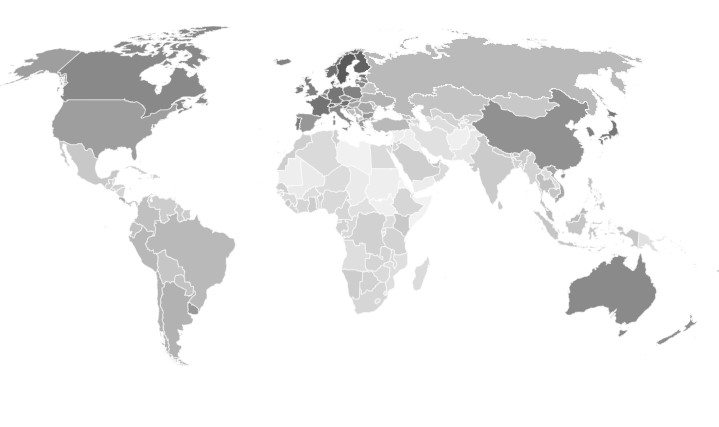
Dark colour indicates higher, light colour lower sustainable competitiveness level
State of the World 2024
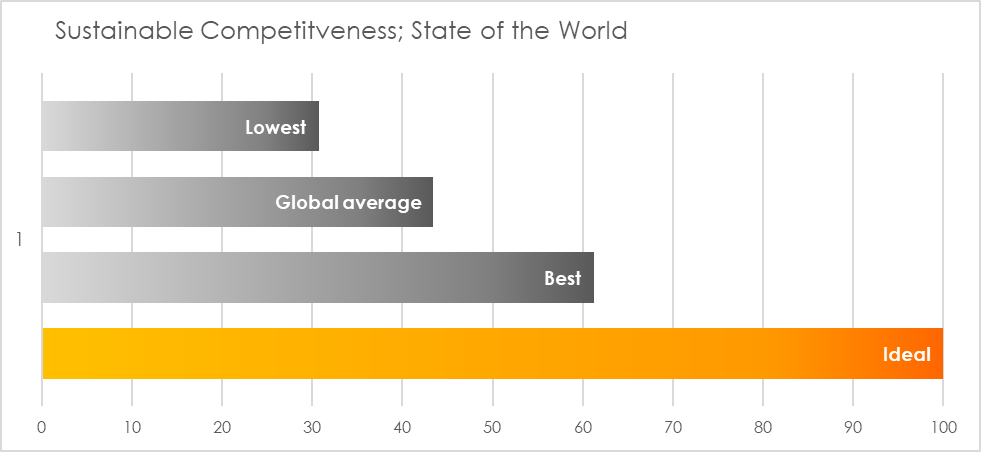
Untapped potential
The highest score achieved in 2024 is 61.2 (Sweden), while the global average is 43.3 out of a possible 100 "best practice" score. The World is far from being sustainable and competitive.
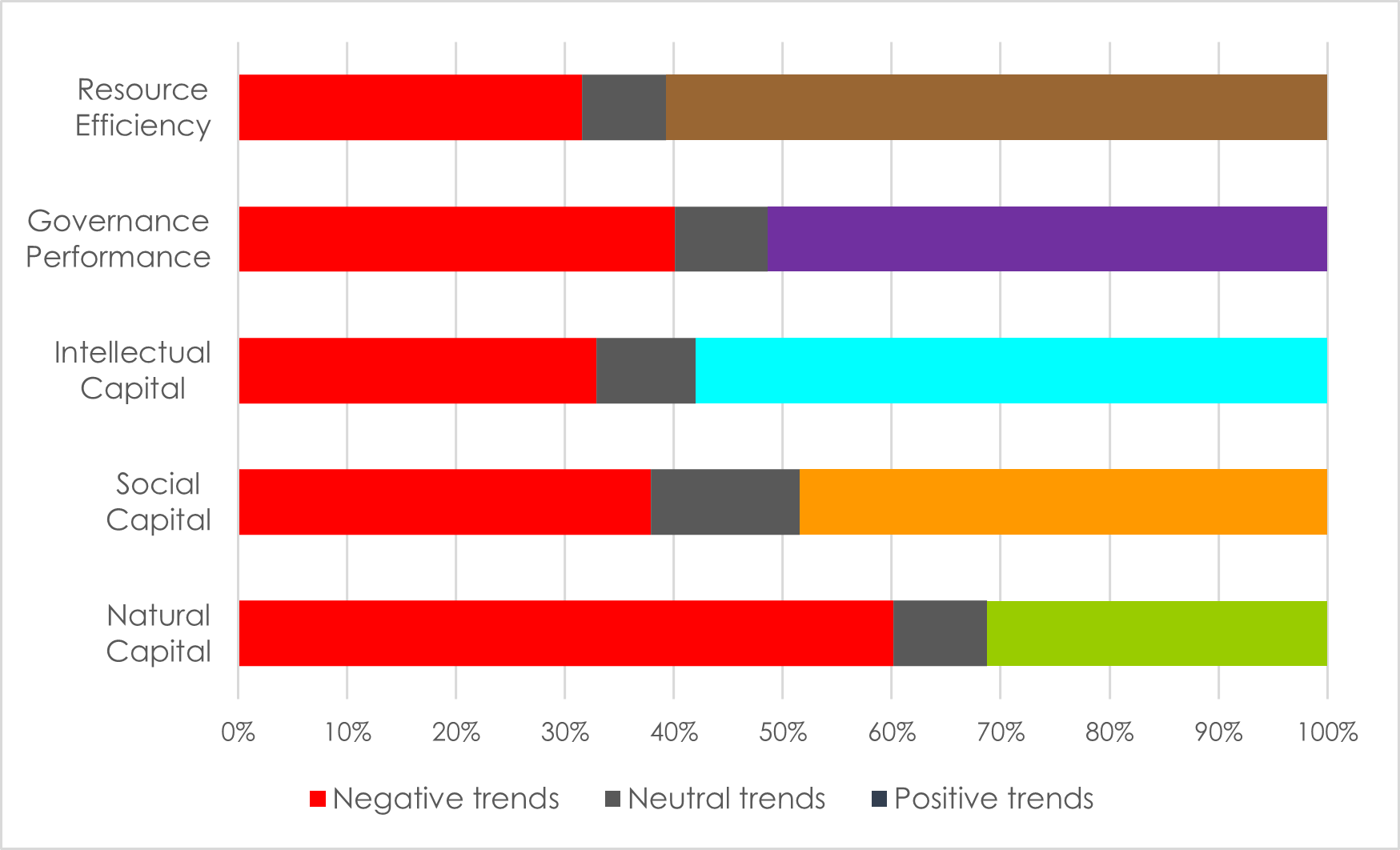
Sustainable Competitiveness Trends
A small majority (52%) of all trends across all countries are showing positive developments, indicating that we could expect slow but positive improvements under normal circumstances. However, a majority of trends in Natural Capital are deteriorating: unfortunately, we have to expect a further decline in the natural environment.
GSCI-based ESG sovereign bond ratings
Sovereign bond ratings are heavily influenced by the large rating providers – Moody's, S&P, and Fitch. A comparison of the conventionally applied sovereign bond ratings and ESG country credit ratings based on the Global Sustainable Competitiveness Index (GSCI) shows (read more about ESG vs Credit Ratings):
- ESG-adjusted ratings and conventional ratings show significant differences. Under a sustainability-adjusted credit rating, countries with high reliance on exploitation of natural resources would be rated lower, while some of the lesser developed countries with a healthy fundament (biodiversity, education, governance) would receive higher ratings.
- Sovereign bond ratings do not sufficiently reflect the non-tangible risks and opportunities associated with specific nation-economies
- Sovereign bond ratings show a high correlation to GDP/capita levels. Poor countries are due higher interest rates than rich countries.
- Sovereign bond ratings can facilitate a negative circularity: bad credit ratings lead to higher cost of capital and debt servicing, which in turn led to bad credit rating.
ESG Sovereign Bonds World Map
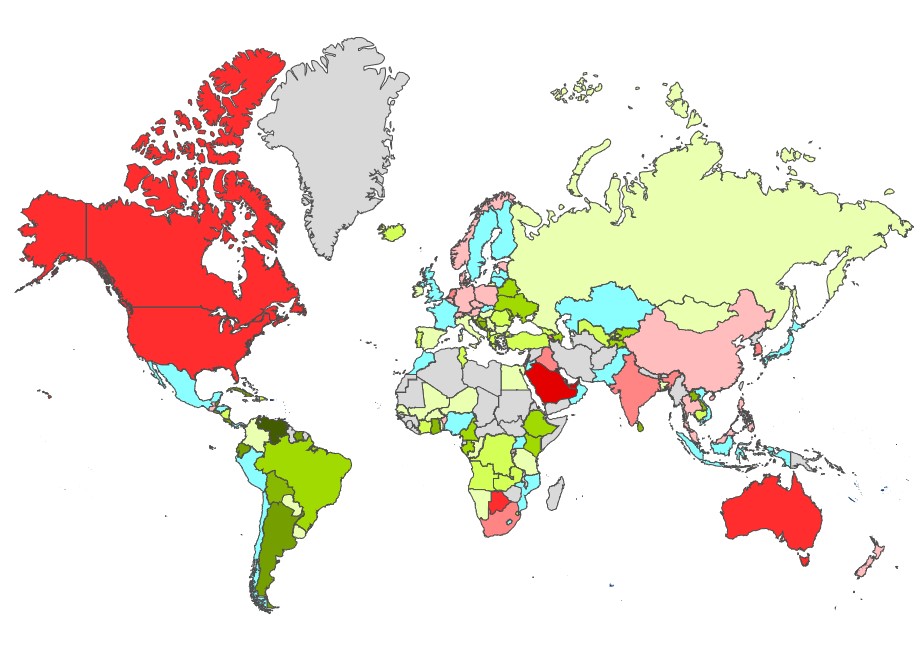
Credit rating World Map: red indicates lower, green higher, and blues equal GSCI credit rating vs. conventional credit rating
Conventional vs GSCI-based ESG Credit Ratings
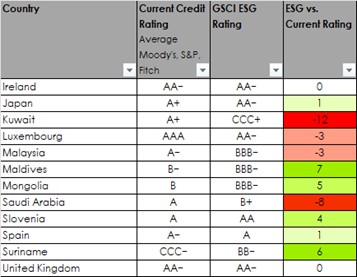
Conventional sovereign bonds rating vs GSCI-based ESG credit ratings for selected countries
Explore the Full Index
Access comprehensive rankings, dimension analysis, and interactive data for 192 countries.
View the GSCI Interactive Index