The Global Sustainable Competitiveness Index, published since 2012, measures the sustainability and competitiveness of countries based on more than 200 quantitative indicators. This article outlines the fundamental policies that enable countries to increase both sustainability and competitiveness simultaneously—creating prosperity that endures rather than prosperity that destroys the foundations of future wealth.

Defining Sustainable Competitiveness
Sustainable competitiveness is the ability to generate and sustain inclusive wealth without diminishing the future capability of sustaining or increasing current wealth levels.
It requires balancing economic performance with the preservation of natural capital, social capital, and intellectual capital upon which all prosperity depends.
Where We Are: The Global Polycrisis
Humanity currently faces interconnected crises that our existing systems seem unable to address effectively. These crises are not separate problems but symptoms of systemic failures in how we organize economies, societies, and our relationship with nature.
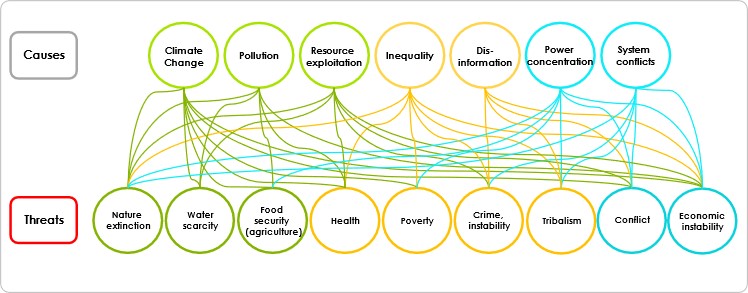
The Interconnected Crises We Face:
- Climate Emergency: Runaway climate change manifests through heat waves, drought, wildfires, storms, rain-bombs, hail, and landslides. These extremes increasingly threaten food security globally. The transition away from fossil fuels is both economically rational and environmentally essential.
- Environmental Degradation: The pollution of air, water, and soil; the extinction of species through habitat destruction; the depletion of natural resources that sustain all economic activity
- Rising Inequality: Growing wealth gaps within and between countries erode social cohesion and create political instability
- Power Concentration: Increasing concentration of wealth and power in fewer corporations and individuals undermines democratic governance and accountability
- Technological Disruption: Rapid advancement in artificial intelligence and automation creates opportunities but also risks of displacement and control
Our current systems have destroyed much of the nature upon which we depend for food, clean water, and stable climate. We have eroded the social fabric within and between countries. We are undermining the very foundations required for survival and prosperity.
This polycrisis unfolds against intensifying geopolitical tensions between different governance models—liberal democracies versus autocratic systems. Neither model, in its current form, adequately addresses these interconnected challenges. Both are failing to protect the environmental systems and social structures that sustain civilization.
Where We Want to Go
A sustainable and competitive world is one where:
- Economic prosperity grows without degrading the environmental systems that sustain it
- Opportunity and wealth are broadly shared, creating stable, cohesive societies
- Innovation and education enable continuous adaptation to challenges
- Governance systems are accountable, transparent, and effective
- Natural ecosystems are preserved and regenerated for future generations
- All people have access to healthcare, education, and opportunity regardless of background
This vision is not utopian—it is achievable through systematic policy reforms implemented with political will and international cooperation. The countries ranking highest in the Global Sustainable Competitiveness Index demonstrate that sustainability and prosperity reinforce rather than contradict each other.
How We Get There: 13 Key Policies for Sustainable Competitiveness
Achieving sustainable competitiveness requires comprehensive reforms across governance, economy, society, and environmental management. These 13 policies provide a framework for transformation:
1. Global Climate Pricing with Money-Back
Tax all climate emissions globally at uniform levels. Return 50% directly to citizens as cash dividends (building political support), allocate 40% to renewable infrastructure deployment, and dedicate 10% to climate adaptation and mitigation measures.
This approach addresses climate change while protecting vulnerable populations from energy cost increases. Countries with strong governance capacity can implement carbon pricing most effectively.
2. Internalizing All External Costs
Integrate all external environmental and human health costs of substances and processes into prices through globally coordinated mechanisms. This ensures markets reflect true costs, making sustainable alternatives economically competitive. The declining cost of renewable energy demonstrates how proper pricing accelerates transitions.
3. Deepening Democracy
Implement proportional voting systems to eliminate "winner takes all" outcomes. Allocate government ministries according to voter share, ensuring representation reflects public preferences. Conduct regular referenda on decisive issues to hold politics accountable between elections.
Proportional systems reduce polarization and encourage coalition-building, creating more stable and representative governance.
4. Distributed Governance Power
Eliminate concentration of executive power in single individuals. Replace Prime Ministers and Presidents with collective leadership by ministry heads. Similarly, replace CEOs in large corporations with collective leadership by department heads.
Distributed power structures reduce corruption risks, improve decision quality through diverse perspectives, and prevent autocratic tendencies in both government and business.
5. Functional Financial Markets
Markets must serve the real economy, not vice versa. Eliminate perception-driven bubbles and short-term rent-seeking through minimum holding periods and/or transaction fees on financial assets. Require examination of new financial instruments for adverse systemic impacts before approval.
Stable financial systems support long-term investments in environmental protection and sustainable infrastructure.
6. Universal Quality Education
Increase educational spending, allocated at state level to ensure equal education for all. Emphasize vocational training alongside academic pathways. Base all education on science and evidence, not ideology or religion.
Education is the foundation of intellectual capital and innovation capacity. Countries that invest in universal, high-quality education create the human capital necessary for sustainable development.
7. Fact-Based, Impartial Information
Require verified human identity for social media accounts and online posting, eliminating bot-driven propaganda. Establish tax-financed, impartial information networks independent of government control, based on scientific evidence. Ban electronic political advertising. Mandate that apps include relevant public information in all feeds or face IP blocking.
Reliable information infrastructure strengthens social trust and enables informed democratic participation.
8. Universal Healthcare and Social Security
Finance essential healthcare and social security through salary-deducted percentage of income, ensuring universal access. Healthcare is a foundation of social capital and economic productivity. Countries with universal healthcare demonstrate better health outcomes at lower costs than fragmented systems.
9. Accessible, Impartial Justice
Ensure impartial judicial staff and efficient processes, enabling access to legal rights for all while minimizing abuse. Swift, fair justice builds trust in institutions and supports rule of law—essential foundations for sustainable governance.
10. Unified Global Taxation
Establish globally agreed brackets for tax rates on individuals and entities, with coordinated processes for taxing multinational corporations. Increase marginal tax rates on extreme wealth to reduce inequality.
Coordinated taxation prevents race-to-the-bottom tax competition and ensures corporations contribute fairly to societies where they operate.
11. Freedom For and From Religion
Faith is a choice; science is not. Everyone is free to practice their faith, and no one has their freedom impaired by others' faith. Maintain total separation of state governance and religion. Base policy on evidence, not religious doctrine.
12. Total Equality
Ensure total equality between genders, races, regions, nationalities, and wealth levels. Discrimination undermines social cohesion and wastes human potential. Equality creates conditions for all individuals to contribute fully to society and economy.
13. Climate Emergency Management
Implement emergency measures to protect food and water security: nationalize food supply chains where necessary; invest in high-tech and nature-based agricultural solutions; eliminate food waste; convert agricultural land from animal feed to crops for human consumption; implement heat protection through urban greening; increase water efficiency and availability.
Climate adaptation protects natural capital and ensures resilience as climate impacts intensify.
Implementation: From Vision to Reality
These policies are mutually reinforcing. Climate pricing funds renewable transition. Education creates innovation capacity. Healthcare builds productive populations. Equality strengthens social cohesion. Together, they create virtuous cycles of sustainable development.
Implementation requires political will, international cooperation, and sustained commitment across election cycles. Countries need not implement all policies simultaneously—progress in any dimension improves overall sustainable competitiveness. However, the interconnected nature of these challenges means comprehensive approaches yield superior results to piecemeal reforms.
The Global Sustainable Competitiveness Index tracks country performance across these dimensions, providing benchmarks for progress and identifying policy gaps. Nations that lead in sustainable competitiveness demonstrate that environmental protection and economic prosperity are complementary, not contradictory goals.
The transition to sustainable competitiveness is not optional—it is essential for survival and prosperity.
Countries that act decisively will gain competitive advantages as resource constraints intensify, climate impacts accelerate, and global cooperation on sustainability strengthens. Those that delay face stranded assets, social instability, and economic decline.
Learn More
For detailed analysis of how these policies impact country rankings, explore the Global Sustainable Competitiveness Index or download the comprehensive report "Sustainable. Competitive." which provides in-depth methodology, country analysis, and policy recommendations.