Renewable electricity is now the cheapest form of energy, and electric vehicles and heating cheaper than fossil. Demand for fossils is to peak in 2025, and drastically decline after 2030.
The End of the Fossil Fuel Era
Controlling fire is what distinguished humans from other species. It allowed us to survive and thrive in colder climate. Making a fire is age-old technology.
When using fire in technological applications, transforming heat energy to movement, the efficiency is limited by the laws of thermal physics to roughly 35%. Electricity in contrast, has an energy-to-movement efficiency of 100%.
Making a fire might be romantic, but is not very efficient.
The Renewable Revolution: Dramatic Cost Reductions
Incentives, investments and mass production have made renewable solar and wind electricity the cheapest form of energy in human history:
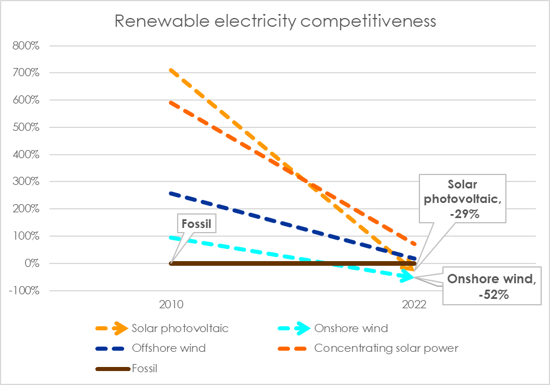
Development of renewable electricity costs: cost for solar PV are now 8 times less than in 2010; wind electricity 4 times less
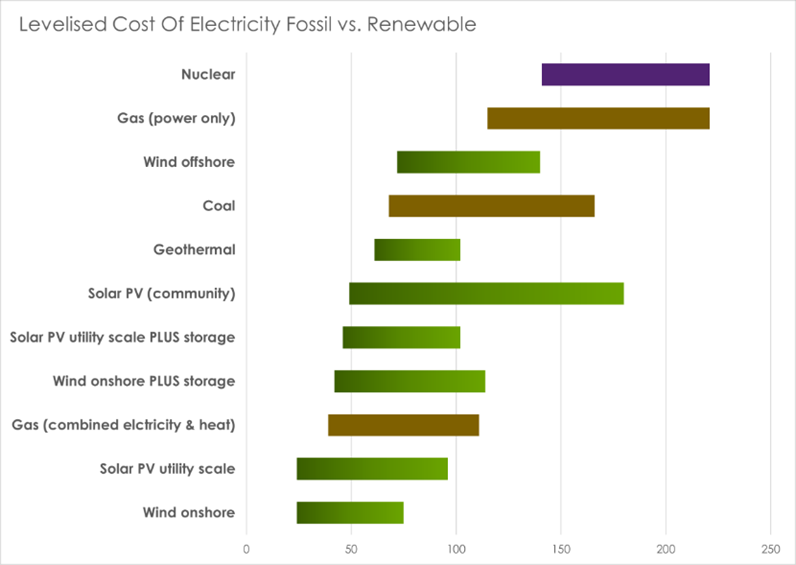
Solar and wind are now the cheapest form of electricity generation – at 40% of the cheapest fossil alternative (combined heat-power gas turbines)
Market dynamics and increasing investments are expected to further decrease cost by 50% over the next 5-10 years.
Renewable vs. Fossil: The Economics Speak Clearly
With decreasing cost of renewable and battery technology, renewables are cheaper even when accounting for storage.
New renewable technology – generation, heating, and transport – is now cheaper than the fossil-fired equivalents, by a factor of 2 or more.
Investments driven by market dynamics are set to further improve technology and reduce costs in the near future – by around 50% in the next 5 years (batteries) to 10 years (renewable generation).
The Economic Argument: Market Developments
Electric Vehicles: Superior Economics
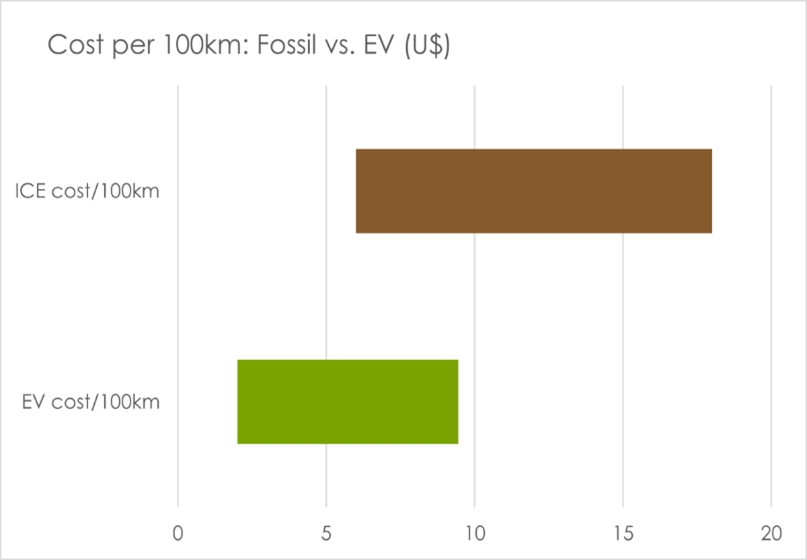
The efficiency of an internal combustion engine is limited by the laws of thermo-physics, and can reach a maximum of 35%. In ICE cars, between 20-25% of the energy contained in the gasoline is turned into moving energy. Electric motors directly convert energy to movement, and can reach up to 100% efficiency.
Heat Pumps: Efficient Heating
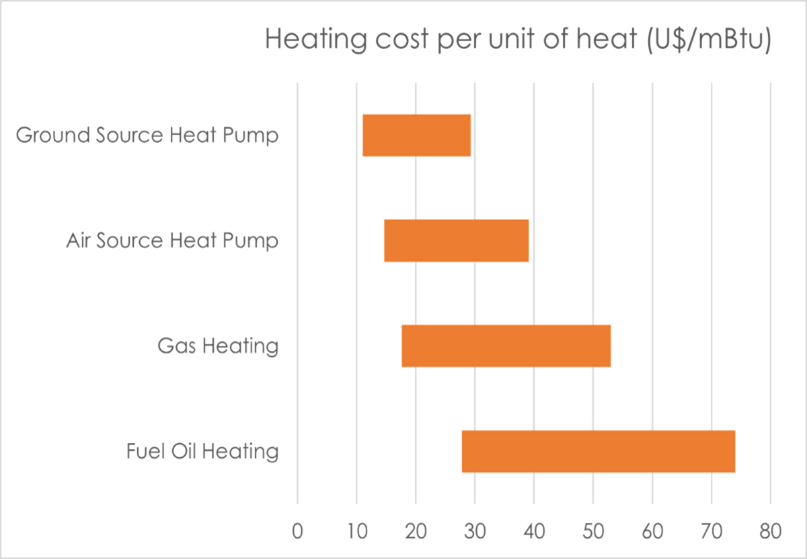
The operating cost of a heating device depends on a set of variables – electricity generation cost, taxes and/or tax breaks on fossil energy, and VAT. In the worst case, heat pump operating costs are comparable to fossil-fired heating systems. Under normal circumstances, heat pump's operating costs are significantly lower due to the higher factor between energy input and energy output.
Battery Technology: Continuous Improvement
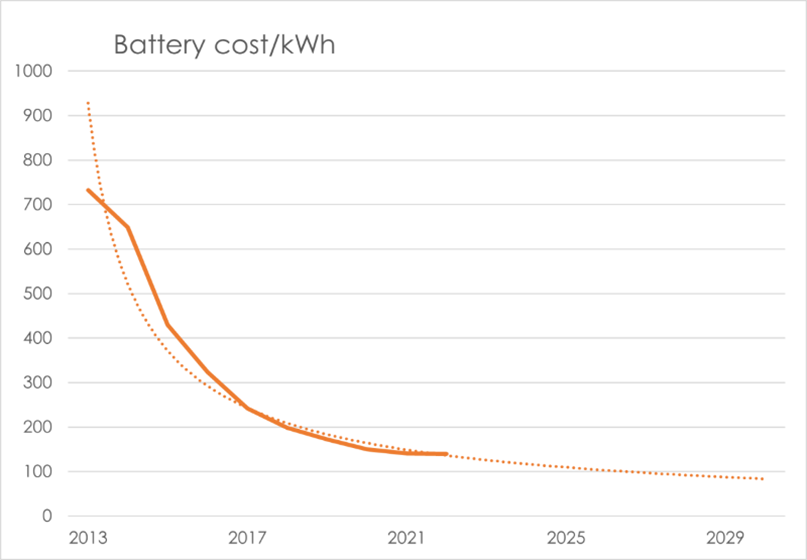
Battery cost have been reduced 4-fold since 2010. Given the global investment push into battery technology, costs are expected to decline further significantly, making renewable electricity and electric road transport even more competitive.
Renewable energy is now the cheapest form of energy in human history
At a cost of 40% of the cheapest form of fossil electricity generation (gas), and with electric appliances being 2-5 times more efficient than fossil counterparts, fossil fuels are no longer competitive.
Peak Oil Demand: 2025-2027
The International Energy Agency (IEA) predicts that global demand for oil will peak between 2025 and 2027 due to cheaper alternatives. When demand starts to decline, prices start to fall. The demand-supply-equation kicks in: over-capacity will lead to price competition, further putting pressure on revenues and profit margins.
It is highly likely that demand for, and revenues generated from fossils will decline somewhere between significantly and drastically after 2030.
Future Energy Mix Scenarios
Under a business-as-usual scenario, the deployment and development of renewables and electricity-powered consumption is expected to start biting noticeably into fossil demand by 2028, accelerating after 2030 due to market dynamics. It should be noted that past projections tended to underestimate the power of economics at the base of the rapid deployment of renewables.
Future energy mix projection taking into account potential policies combating climate change shows the proportion of fossil energy is expected to start decline after 2026, with accelerating pace of deployment of renewables after 2028. Depending on the quality of climate policies (incentive and financing frameworks for renewables, taxing of fossils), renewables will cover 100% of all energy needs between 2032 to 2037.
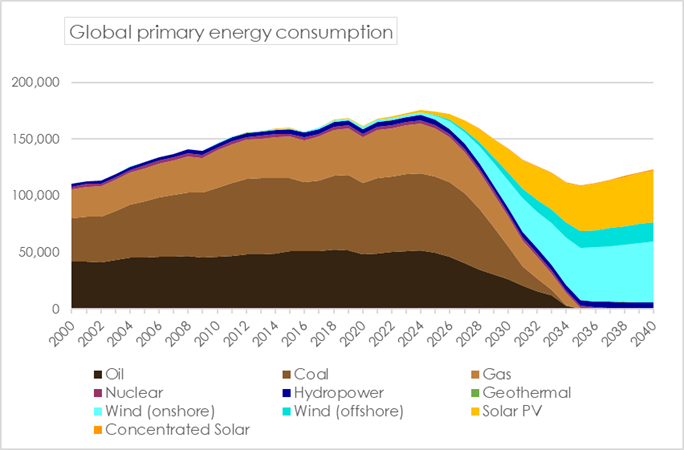
Business as Usual Scenario
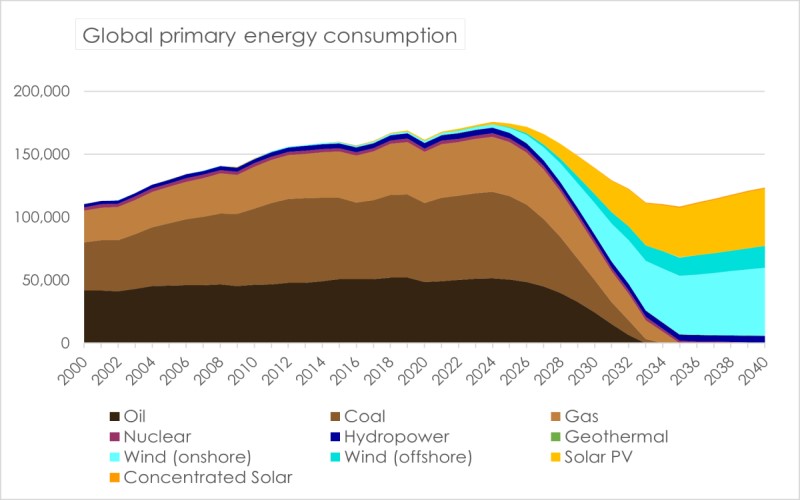
Climate Policy Scenario
Implications for Investors and Policy Makers
Investors, Beware: Fossils Are No Longer Competitive
- The markets for renewables and electricity-powered consumption have reached momentum that is now unstoppable. It's simple economics: Renewables are – by a large margin – more efficient and cheaper
- Market developments flush more investments in R&D, production and installation – everything renewable and electric will become even cheaper in the near future. The outlook suggests half the cost in the next 10 years, redoubling market dynamics
- As a consequence, fossils and fossil-powered consumption are no longer competitive. Demand for oil will peak between 2025 and 2027, and therefore start to decline, slowly at first, and faster over time
- Demand, revenues and profits for and from fossils will decline in accordance
- The renewable transition will happen faster than the "mainstream" is currently expecting
- Demand for oil will decline after 2025. And drastically so after 2030 – even assumed a business-as-usual scenario with no or very limited climate change-forced policies
- Policies and targets induced by climate change (e.g. incentives and financing framework for renewables, and taxing of fossils) are likely further accelerating market dynamics
- It is highly likely that the demand for fossils will be a fraction of today's, and maybe even close to zero by 2040
Implications for National Competitiveness
The energy transition has profound implications for national sustainable competitiveness. Countries that lead in renewable energy deployment and electric technology manufacturing will gain economic advantages, while fossil-dependent economies face structural challenges.
Nations heavily dependent on fossil fuel revenues must urgently diversify their economies. The governance capacity to manage this transition will determine whether countries successfully adapt or face economic crisis. Investment in education and innovation becomes critical for building competitive renewable energy sectors.
The shift away from fossil fuels also affects sovereign credit ratings. Countries with high fossil fuel dependency face increasing financial risk as oil demand declines. ESG-adjusted sovereign bond ratings increasingly reflect these transition risks, with fossil-dependent nations facing potential downgrades as their revenue bases erode.
The Social and Environmental Dividends
Beyond economics, the renewable transition delivers massive social benefits. Air quality improvements from reduced fossil fuel combustion prevent millions of premature deaths annually. Renewable energy creates more jobs per dollar invested than fossil fuels, supporting employment transitions.
The environmental benefits are equally profound. Transitioning away from fossil fuels is essential for protecting natural capital and preventing catastrophic climate change. Every percentage point reduction in fossil fuel use reduces greenhouse gas emissions, slows global warming, and preserves ecosystems for future generations.
The Path Forward
The economic case for renewable energy is now overwhelming. Market forces alone will drive substantial fossil fuel displacement. However, the pace of transition matters immensely for climate outcomes. Accelerating the renewable transition through policy support—carbon pricing, renewable subsidies, fossil fuel subsidy elimination—can prevent the worst climate impacts while capturing economic opportunities.
Countries, companies, and investors that recognize this reality early will gain competitive advantages. Those that delay—betting on fossil fuel resurgence or gradual transition—face stranded assets, economic losses, and competitive disadvantages.
The age of fossil fuel dominance is ending not through regulation alone, but through superior economics. Renewable energy and electric technology have won the competition. The only question now is how quickly societies adapt to this new reality.
Want to learn more?
For detailed analysis, projections, and methodology, download the full report on why fossil fuels are no longer competitive.
Download Full Report